
Becoming an IAS (Indian Administrative Service) Officer is one of the most respected career goals in India. IAS Officers play an important role in managing government administration, implementing policies, and improving public services. Every year, thousands of students prepare for the UPSC Civil Services Examination to achieve this dream. Although the selection process is highly competitive, it can be cleared with proper planning, regular study, and dedication.
To become an IAS Officer, candidates must meet the required educational qualification, age limit, and other eligibility conditions. They also need to successfully clear the Preliminary Examination, Main Examination, and Personality Test conducted by UPSC. Understanding the complete process is the first step toward success.
In this career guide, you will learn everything about how to become an IAS Officer, including eligibility, exam pattern, preparation tips, salary, career growth, and the step-by-step process to achieve your goal.
Who is an IAS Officer?
An IAS (Indian Administrative Service) Officer is one of the highest-ranking government officers in India. They work in different government departments and help implement government policies, manage administration, and solve public problems.
Why Should You Become an IAS Officer?
There are many benefits of becoming an IAS Officer:
- High respect in society
- Good salary and government benefits
- Opportunity to serve the country
- Job security
- Career growth and promotions
Educational Qualification
To become an IAS Officer, you must:
- Pass Class 10.
- Pass Class 12 from a recognized board.
- Complete a Bachelor’s Degree from a recognized university.
You can choose any stream or subject for graduation
Age Limit
To apply for the UPSC Civil Services Examination:
- Minimum Age: 21 Years
- Maximum Age: 32 Years (General Category)
Age relaxation is available for reserved categories according to government rules.
Step-by-Step Process to Become an IAS Officer
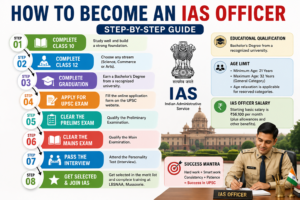
Step 1: Complete Class 10
Study well and build a strong foundation in all subjects.
Step 2: Complete Class 12
Choose a stream based on your interest, such as Science, Commerce, or Arts.
Step 3: Complete Graduation
Earn a Bachelor’s Degree from a recognized university.
Step 4: Apply for the UPSC Exam
Visit the official UPSC website and fill out the online application form.
Step 5: Clear the Preliminary Exam
The first stage is the UPSC Preliminary Examination.
Step 6: Clear the Main Examination
Candidates who pass the Prelims appear for the Main Examination.
Step 7: Attend the Interview
Qualified candidates are called for the Personality Test (Interview).
Step 8: Get Selected
The final merit list is prepared based on the Mains and Interview scores. Successful candidates receive IAS training.
UPSC Exam Pattern
The UPSC Civil Services Examination is conducted in three stages. Candidates must clear each stage to move to the next one. The Preliminary Examination is the first stage and is used to shortlist candidates for the Main Examination. After qualifying for the Mains, candidates are called for the Personality Test (Interview). The final merit list is prepared based on the marks obtained in the Main Examination and Interview. Understanding the exam pattern before starting your preparation will help you create a better study plan and focus on the right subjects.
| Stage | Details |
|---|---|
| Preliminary Examination (Prelims) | Two objective-type papers: General Studies Paper I and CSAT. |
| Main Examination (Mains) | Nine papers, including Essay, General Studies, Optional Subject, and Language papers. |
| Personality Test (Interview) | Candidates are assessed on their personality, communication skills, decision-making ability, and overall suitability for the IAS post. |
Note: Candidates must qualify in each stage to proceed to the next stage of the UPSC selection process.
Skills Required
To become a successful IAS Officer, you should develop these skills:
- Good communication
- Leadership
- Decision-making
- Problem-solving
- Time management
- General knowledge
- Confidence
IAS Officer Salary
A newly appointed IAS Officer receives a starting basic salary of ₹56,100 per month. They also receive government allowances such as DA, HRA, and TA, along with other official benefits.
Best Tips for UPSC Preparation
If you are starting your IAS preparation for the first time, do not worry. Every successful IAS Officer was once a beginner. The first step is to understand the UPSC syllabus and exam pattern. This will help you know what to study and what to avoid.
Start with NCERT books because they explain basic concepts in simple language. After that, read standard books for each subject. Spend at least 5–6 hours studying every day and follow a fixed timetable. Instead of studying for long hours at once, study in small sessions and take short breaks.
Read a newspaper every day to stay updated with current affairs. Make short notes while studying so you can revise them before the exam. Solve previous years’ question papers to understand the exam level and practice mock tests regularly to improve your speed and confidence.
Do not buy too many books or follow too many teachers. Choose a few good study materials and complete them properly. Stay patient, revise regularly, and never lose confidence. Remember, success in the UPSC exam comes from daily practice, smart planning, and consistent hard work, not from studying for one or two days.
Common Mistakes to Avoid
- Studying without a plan
- Ignoring current affairs
- Not revising regularly
- Changing books too often
- Skipping mock tests
Conclusion
Becoming an IAS Officer requires hard work, patience, and dedication. Start your preparation early, stay focused, and study consistently. With the right strategy and regular practice, you can achieve your goal of becoming an IAS Officer and serving the nation.
Frequently Asked Questions (FAQ)
Q1. What is an IAS Officer?
Answer: An IAS (Indian Administrative Service) Officer is a government officer who manages administration, implements government policies, and works for the development of the country.
Q2. What qualification is required to become an IAS Officer?
Answer: You must have a Bachelor’s Degree from a recognized university. Students from any stream can apply for the UPSC Civil Services Examination.
Q3. What is the minimum age to become an IAS Officer?
Answer: The minimum age is 21 years. The maximum age limit depends on the candidate’s category as per UPSC rules.
Q4. Which exam is required to become an IAS Officer?
Answer: You must clear the UPSC Civil Services Examination (CSE), which includes the Preliminary Exam, Main Exam, and Personality Test (Interview).
Q5. Can I become an IAS Officer after Class 12?
Answer: No. After Class 12, you must first complete a Bachelor’s Degree before applying for the UPSC examination.
Q6. How many stages are there in the UPSC selection process?
Answer: The selection process has three stages: Preliminary Examination, Main Examination, and Personality Test (Interview).
Q7. What is the starting salary of an IAS Officer?
Answer: The starting basic salary of an IAS Officer is ₹56,100 per month, along with government allowances and other benefits.
Q8. How long does it take to prepare for the IAS Exam?
Answer: Most candidates spend 1 to 2 years preparing seriously for the UPSC Civil Services Examination. The preparation time may vary based on your knowledge and study plan.
Q9. Which stream is best for becoming an IAS Officer?
Answer: There is no fixed stream. Students from Science, Commerce, and Arts can all become IAS Officers if they meet the eligibility criteria and clear the UPSC examination.
Q10. Is it difficult to become an IAS Officer?
Answer: Yes, the UPSC exam is one of the toughest competitive exams in India. However, with the right strategy, regular study, and consistent practice, you can achieve your goal.