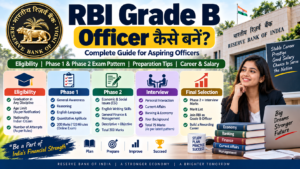

If you want to build a career in banking, finance, and the government sector, RBI Grade B Officer is an important career option. RBI Grade B is an officer-level post in the Reserve Bank of India (RBI).
The exam is not only about banking. You also need to understand the Indian economy, finance, current affairs, reasoning, English, and management.
In this guide, we will explain how to become an RBI Grade B Officer step by step, including eligibility, exam pattern, subjects, preparation strategy, and interview.
Note: Eligibility and exam rules can change with every recruitment. Always check the latest RBI notification before applying.
Step 1: Understand What an RBI Grade B Officer Is
The Reserve Bank of India is the central bank of India. It plays an important role in the country’s banking and financial system.
An RBI Grade B Officer works in different areas of RBI, depending on the department and role.
RBI Grade B recruitment mainly includes different streams such as:
- Grade B General
- Grade B DEPR
- Grade B DSIM
For most graduates, Grade B General is the main exam to consider because candidates from different graduation backgrounds can apply if they meet the required eligibility conditions.
Step 2: Check RBI Grade B Eligibility
Before starting your preparation, first check whether you are eligible.
Educational Qualification
For Grade B General, candidates generally need a graduation degree in any discipline from a recognised university, along with the required percentage mentioned in the latest notification.
This means you do not necessarily need a degree in Economics or Commerce for the General stream.
Candidates with a postgraduate degree can also be eligible under the conditions given in the official notification.
Age Limit
The age limit is also given in the RBI recruitment notification.
For example, in the 2026 recruitment, the prescribed age range for Grade B General was 21 to 30 years, with age relaxation for eligible categories as per the rules.
Because the cut-off date and relaxation rules can change, always check the latest notification.
Attempts
There is also an attempt limit for some categories in RBI Grade B General.
For example, the 2026 notification prescribed a maximum of 6 attempts in Phase 1 for General/EWS candidates, while the restriction does not apply to certain reserved categories as specified by RBI.
Step 3: Understand the RBI Grade B Selection Process
The RBI Grade B General selection process can be understood in three main stages:
Phase 1 → Phase 2 → Interview
First, you have to clear Phase 1.
Candidates who qualify for Phase 2 then appear for the Phase 2 examination.
After Phase 2, shortlisted candidates are called for the Interview.
So, your preparation should not stop after Phase 1. You should start learning Phase 2 subjects from the beginning.
Step 4: Understand the Phase 1 Exam Pattern
Phase 1 is an online objective examination.
It has four sections:
| Subject | Questions | Marks |
| General Awareness | 80 | 80 |
| Reasoning | 60 | 60 |
| English Language | 30 | 30 |
| Quantitative Aptitude | 30 | 30 |
| Total | 200 | 200 |
The total duration is 120 minutes.
- General Awareness
General Awareness is an important part of Phase 1.
You should focus on:
- RBI and its functions
- Banking awareness
- Indian economy
- Financial system
- Monetary policy
- Government schemes
- Budget
- Economic Survey
- National current affairs
- International current affairs
- Important financial developments
Do not study current affairs only a few days before the exam. Make it a daily habit.
- Reasoning
Reasoning checks your logical thinking and problem-solving ability.
- Important topics include:
- Puzzles
- Seating arrangement
- Syllogism
- Inequality
- Coding-decoding
- Blood relations
- Direction
- Data sufficiency
- Logical reasoning
Start with basic concepts and then move to difficult questions.
- Quantitative Aptitude
You do not need to be a mathematics expert.
Start with basic topics such as:
- Percentage
- Ratio
- Average
- Profit and Loss
- Time and Work
- Time, Speed and Distance
- Simple and Compound Interest
- Data Interpretation
Regular practice is important because speed matters in the exam.
- English Language
English tests your reading and language skills.
- Important areas include:
- Reading comprehension
- Grammar
- Vocabulary
- Error detection
- Sentence correction
- Fill in the blanks
Reading English articles regularly can help you improve both vocabulary and comprehension.
Step 5: Start Your Phase 1 Preparation
Once you understand the syllabus, make a daily study plan.
A simple routine can be:
General Awareness – 2 hours
Read current affairs, banking news, RBI-related topics, and economic developments.
Reasoning – 1 hour
Practice questions and note down your mistakes.
Quantitative Aptitude – 1 hour
Work on concepts and calculation speed.
English – 30 to 45 minutes
Read an article and practice questions.
You should also take regular mock tests.
After every mock test, check your mistakes. Simply giving more tests will not help much if you do not understand why you made mistakes.
Step 6: Understand Phase 2 Exam Pattern
Phase 2 is a very important stage of RBI Grade B.
For the General stream, there are three papers:
Paper 1 – Economic and Social Issues (ESI)
This paper covers topics related to the Indian economy and society.
- You should study:
- Indian Economy
- Economic Growth
- Economic Development
- Poverty
- Employment
- Sustainable Development
- Social issues
- Government policies
- Globalisation
- Economic reforms
- International organisations
Do not just memorise definitions. Try to understand how different economic policies affect people and businesses.
Paper 2 – English Writing Skills
This paper checks your English writing and understanding.
You may have to write answers on given topics.
For this paper, practice:
- Essay writing
- Reading comprehension
- Summary writing
- Clear sentence formation
Proper paragraph structure
You do not need to use very difficult English.
Simple, clear and well-organised writing is more useful than using complicated words.
Try writing one short answer every day.
Paper 3 – General Finance and Management
This paper covers both Finance and Management.
Finance topics may include:
- Financial system
- Banking system
- Financial markets
- Money market
- Capital market
- RBI functions
- Financial regulation
- Risk management
- Financial inclusion
- Management topics may include:
- Management basics
- Leadership
- Motivation
- Communication
- Human Resource Management
- Organisational Behaviour
- Ethics
- Corporate governance
If you are new to these subjects, first understand the basic concepts. After that, move towards exam-level questions.
Step 7: Prepare for the RBI Grade B Interview
After Phase 2, shortlisted candidates are called for the Interview.
The Interview is an important part of the final selection process.
You should be ready for questions related to:
- RBI
- Banking
- Indian economy
- Current affairs
- Your graduation subject
- Your education
- Your career goals
- Basic financial concepts
- Why you want to join RBI
For example:
- What is RBI?
- What is inflation?
- What is repo rate?
- What is monetary policy?
- Why do you want to become an RBI Grade B Officer?
- Do not try to memorise every answer.
Understand the topic and practice speaking in your own words.
Step 8: Follow a Long-Term Preparation Plan
If you are starting from zero, you can follow this type of roadmap.
Month 1–2: Build Your Basics
- Understand the complete syllabus
- Start Quantitative Aptitude
- Start Reasoning
- Improve English
- Read current affairs daily
- Learn basic banking concepts
Month 3–4: Build Your Knowledge
- Study RBI-related topics
- Start Indian Economy
- Learn Finance basics
- Start Management
- Practice topic-wise questions
- Continue current affairs
Month 5–6: Exam Practice
- Start full-length mock tests
- Practice previous-year questions
- Improve speed
- Revise important topics
- Start descriptive writing
- Practice ESI and Finance answers
Final Stage
- Focus on:
- Revision
- Mock tests
- Current affairs
- Previous-year questions
- Weak topics
- Descriptive answer writing
Step 9: Develop These Skills
RBI Grade B preparation is not only about completing books.
You should also develop some useful skills.
Reading Skills
Read about banking, finance and the economy regularly.
Writing Skills
Practice writing clear answers in English.
Calculation Skills
Improve your calculation speed for Quantitative Aptitude.
Communication Skills
Practice explaining financial and economic topics in simple words.
Current Affairs Knowledge
Follow important developments related to RBI, banking, economy and government policies.
Conceptual Understanding
Try to understand why something happens, instead of only memorising facts.
RBI Grade B Officer Preparation Roadmap
You can remember the complete journey like this:
Graduation → Check Eligibility → Phase 1 Preparation → Phase 1 Exam → Phase 2 Preparation → Phase 2 Exam → Interview → Final Selection → RBI Grade B Officer
The most important thing is to start with a proper plan.
Do not try to study everything at the same time. Build your basics first and then gradually move towards advanced topics.
Final Conclusion
Becoming an RBI Grade B Officer requires regular preparation and a good understanding of banking, finance, economics and current affairs.
First, check your eligibility. Then understand the complete syllabus and exam pattern. Start with Phase 1 subjects such as General Awareness, Reasoning, Quantitative Aptitude and English.
At the same time, slowly start preparing for Phase 2 because Economic and Social Issues, Finance, Management and English Writing need more detailed study.
Do not depend only on memorisation. Try to understand the concepts and connect them with real-world events.
Most importantly, stay consistent. RBI Grade B preparation can take time, so do not worry if you cannot understand everything in the beginning. Start with the basics, practise regularly, analyse your mistakes and keep improving.
Always check the latest RBI notification before applying because eligibility, vacancies, dates and exam rules may change.
Frequently Asked Questions (FAQs)
1.Can I apply for RBI Grade B after graduation?
Ans: Yes. Candidates with a recognised graduation degree can apply for Grade B General if they meet the marks, age and other conditions mentioned in the latest notification.
2. Is Economics compulsory for RBI Grade B?
Ans: No. Economics is not compulsory as a graduation subject for Grade B General. However, Economics becomes an important part of Phase 2 preparation.
3.How many phases are there in RBI Grade B?
Ans: The selection process for Grade B General includes Phase 1, Phase 2 and Interview.
4.What subjects are in RBI Grade B Phase 1?
Ans: Phase 1 includes General Awareness, Reasoning, English Language and Quantitative Aptitude.
5. What subjects are in RBI Grade B Phase 2?
Ans: Phase 2 includes Economic and Social Issues, English Writing Skills, and General Finance & Management.
6. Is RBI Grade B difficult?
Ans: The exam requires preparation across several subjects. Candidates should focus on concepts, current affairs, mock tests and regular revision.
7. Can final-year graduation students apply?
Ans: It depends on the conditions mentioned in the particular RBI recruitment notification. Always check the educational qualification and cut-off date before applying.
8.Can I prepare for RBI Grade B without a coaching institute?
Ans: Yes. You can prepare through books, official RBI material, previous-year questions, mock tests and reliable study resources. A proper study plan and regular practice are important.